
Memory organized by functional region
Local patterns are modeled in partitioned genomic contexts, reducing semantic mixing and preserving representations that better reflect coding, regulatory, and other functional regions.
Genome Foundation Model
Understand genomic sequences and turn the rules of life into searchable, interpretable, and reusable biological knowledge.
A different foundation
The rules encoded in genomes often reside in local motifs, functional regions, and regulatory relationships across scales. Meno starts from the structure of biological sequences, so the model can show not only what it predicts, but also which knowledge it uses.
Meno architecture
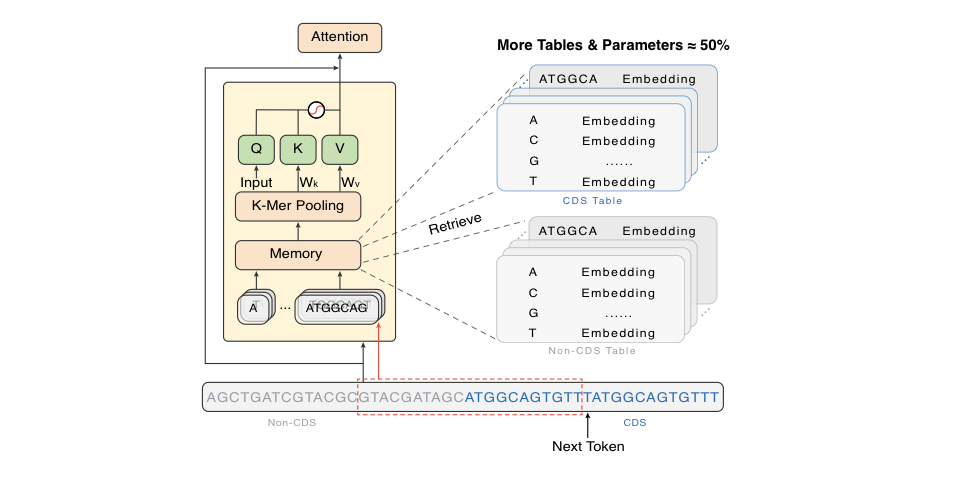
Meno organizes sequence patterns outside model parameters as readable conditional memory, making knowledge formation, retrieval, and iteration more transparent.
Local patterns are modeled in partitioned genomic contexts, reducing semantic mixing and preserving representations that better reflect coding, regulatory, and other functional regions.
For a new sequence, the model retrieves relevant patterns from memory and uses the same evidence for both prediction and interpretation.
Gating signals reveal how different memories contribute to an output, helping researchers inspect the positions, patterns, and functional regions the model relies on.
Interpretable by design
Rather than adding explanations after prediction, Meno preserves observable memory structures while learning and retrieving knowledge, creating clearer leads for biological validation.
Memory space
As memory units organize around sequence context, coding and non-coding regions develop distinct distributions, providing a window into the model's internal biological semantics.
Gate alignment
By examining the relationship between memory activation and functional sequence regions, researchers can formulate more specific and testable biological hypotheses.
One knowledge core
Meno turns model outputs into genomic knowledge assets that can accumulate across tasks, datasets, and experimental cycles.
Identify local patterns, functional regions, and memory contributions that can inform experimental design.
Combine sequence representations with retrievable memory for functional, phenotypic, and regulatory modeling.
Generate and rank candidate sequences around a target function, then update model knowledge with experimental feedback.
From model to validation
Precision medicine research
Analyze variant function, disease-associated sequences, and candidate targets to help research teams narrow the experimental search space.
Synthetic biology
Discover functional elements, optimize sequences, and evaluate candidates while connecting computational design with experimental feedback.
Xenotransplantation CRISPR
Support animal editing programs, including semi-cloned pigs, across sgRNA ranking, donor/HDR design, PCR validation, and experimental feedback.
Note: The capabilities described on this website are intended for research and industrial R&D. They do not constitute medical diagnosis, treatment advice, or claims for a clinical product.
Learning loop
From task definition to experimental feedback, Meno connects models, data, and real biological systems through traceable knowledge iteration.
Set the functional objective, species scope, and validation boundaries
Build task-specific sequence representations and regional context
Call interpretable motifs and conditional memory
Produce rankable, comparable candidate results
Update task knowledge and model capability with validation data
About Meno
Hangzhou Xupu Zhiqi Technology Co., Ltd. develops genome foundation models and interpretable sequence intelligence. Meno extends the research direction of explicit motif memory to build reusable biological knowledge infrastructure for a broader range of genomic tasks.
Seeking partners to validate the rules of life